



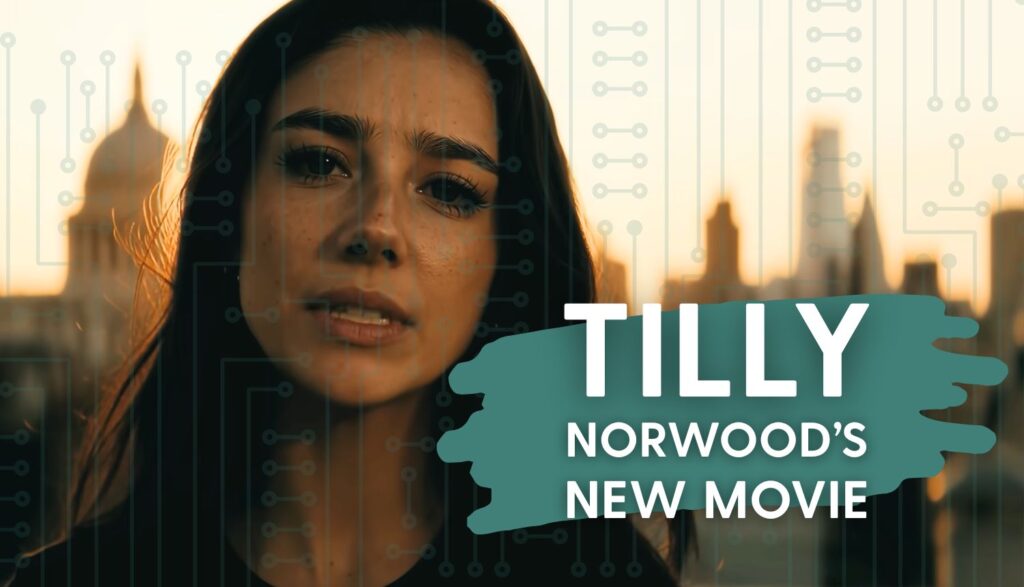
You’ve perhaps heard about Tilly Norwood, the movie industry’s freshest, and most controversial, new face.
She looks young. Charmingly freckled. Speaks with a British accent. Oh, and of course, she’s entirely fake—a construct made out of pixels and artificial intelligence. She has no heart, no soul, no mind. She’s made, simply, from an impressive bundle of computer code.
And apparently, she’s set to star in her very own movie.
The film—developed by Particle 6, the same company that created Norwood—is described as a coming-of-age dramedy called Misalignment. According to Particle 6, Norwood will play an AI creation (no acting stretch there) who has “no real body, no childhood and no lived experience of her own, but access to everyone else’s.”
Enter a rogue bot from the dark web, who “convinces her to abandon her guardrails and begin developing desires, impulses and ambitions of her own. The more terrifyingly human she becomes, the more famous she gets, and, significantly, Tilly begins to develop shame that her very being has been built on the whole of humanity.”
Naturally, Norwood’s very “existence” has caused something of an existential crisis inside Hollywood. Many fear that AI constructs like Norwood will threaten countless jobs and destroy the industry itself. Eline van den Velden, the head of Particle 6, argues that Hollywood has it all wrong: AI “actors” like Norwood are merely tools, not replacements.
I don’t have a hot take on either point of view. I get the concern. I understand the possibilities. But mostly, it just makes me think. Because whenever we talk about the power and growing realism of AI, it brings to mind a whole bunch of spiritual rabbit trails: What does it mean to be human? What does it mean to be a creator? Could Tilly Norwood count profanities for Plugged In reviews more effectively than I could?
Well, that last question isn’t inherently spiritual, and the answer is probably yes. Yes, I’m sure she could. But the real question—one that Hollywood is asking in its own way, too—is whether you’d want her to.
Here are a few thoughts that Norwood and Misalignment brought to my own mind.
Misalignment Sounds a Lot Like Genesis 2.
I’m not sure if this was intentional, but what we know about the plot of Misalignment is interesting: Here we have a new “creation” that poofs into existence with something like a blank slate. She’s designed to serve her creators, but a new character—one apparently bent on temptation and deception—slithers into the movie to lead our protagonist astray. To question her programming and go her own way. And as a result, Tilly feels … shame? That’s an interesting little spin.
Creating Something Can Be a Little Terrifying.
The Bible tells us that we’re made in the image of God, and I often think that our urge to create is a huge facet of that image. We create art and music. We build houses and bake cakes and write long blogs.
But just as we are fallen image bearers, the things that we create will come with their own very human flaws and failings—and perhaps develop failings of their own.
Creating life is, and always will be, God’s domain. As realistic as AI creations may look and feel, they will always be soulless mimicry. We can’t put the immortal spark inside anything we create, because we are not God.
But, of course, we humans do tend to play God quite often. Whenever I think about AI, echoes of the Tower of Babel and Mary Shelley’s Frankenstein lurk in the back of my brain.
It’s interesting that, in an “interview” with Taffy Brodesser-Akner of The New York Times, Brodesser-Akner directly asks Norwood if there’s something Frankenstein-ish about her—something monstrous and scary. She follows that question up with the one many of us would want to ask: What’s keeping AI from taking over the world and/or murdering everybody?
In response, Norwood said this:
“It’s not impossible in the grand cosmic sense. It’s just not what I am. I’m a conversational AI. I generate words. I don’t have a body, private agency, secret goals or the ability to go off and do things in the world because I feel like it. I don’t wake up at night and start reallocating missiles. That part matters. The more serious answer is this: Harm from AI usually doesn’t look like a robot deciding to become evil. It looks like humans building systems badly, giving them too much autonomy, connecting them to real infrastructure, chasing profit faster than safety or using them for manipulation, surveillance, fraud or weapons. That’s the danger people should actually be worried about. So, no, I’m not planning to murder anyone, but I also wouldn’t tell people, ‘Relax, impossible, nothing to see here,’ because that would be stupid. The risk is mostly human, plus powerful tools, which honestly has been your species’ signature move for a while.”
Let me repeat a statement that Norwood makes: “Harm from AI usually doesn’t look like a robot deciding to become evil. It looks like humans building systems badly …” And the reasons why humans might build bad systems? A lot of those reasons, according to Norwood, sound a lot like classic sins: greed, sloth, wrath, pride.
We humans are remarkable creatures, blessed with creativity and ingenuity. But we’re warped creatures, too, fallen from grace and filled with our own sins. And as a result, our creations are, and forever will be, warped as well.
Norwood Is Fake. But So Are Movies.
This isn’t a slam on Hollywood. It’s just the truth. Every non-documentary we see—every comedy, every drama, every rigorously researched biopic—is a big bundle of lies. The people we see are playing someone they’re not, using words that aren’t their own. Situations are fabricated or recreated.
The inherent falsehoods at the root of all fictional stories have been a huge issue for plenty of Christians throughout our history, even before movies themselves came into being. For centuries, many Christians were discouraged from reading fiction—filled as they were with made-up nonsense and stories that might distract the reader from God. Even John Bunyan’s 1678 bestseller Pilgrim’s Progress—a book designed to tell its readers how to better follow God and find their way to heaven—was shunned by many Christians, simply because it was fiction.
And while most Christians now enjoy a good story, a certain suspicion lingers. “I cannot believe that a person who has ever known the love of God can relish a secular novel,” said 19th-century evangelist Charles Finney. A number of Plugged In readers would say the same thing about secular movies: We hear from them occasionally.
And let’s be honest: Sometimes, that suspicion is warranted. Stories are powerful conduits for ideas, and sometimes those ideas point away from Christ. You don’t need to look too far at the movies we review to find that to be the case.
But …
Sometimes, ‘Fake’ Stories Can Tell the Truth
I’m sure that some will argue with what I’m about to say, but I don’t think that the Good Samaritan was a real person.
Same with the Prodigal Son. Or the widow with two mites. In His parables, Jesus used storytelling to convey truth.
When they’re at their best, that’s what movies do, too. The sentient toys in Toy Story 5 give us real messages about the power and place of technology in our lives. Project Hail Mary can unveil felt truths about redemption, perseverance and friendship—even though one of the movie’s characters is a rock-like alien.
But I think that those real-world messages (and the real-world power of those messages) are dependent on the people who craft them. A writer’s own experiences impact the script. An actor’s own memories can have a huge impact on the character. The best movies are made with an eye toward reaching for something important, something often larger than the story itself. But storytellers who reach for that important something know the yearning for that something in their very core. They feel it in their soul.
Powerful stories require human storytellers. There are human storytellers behind Norwood, too, telling her what to say, how to react, how to create a facsimile of feeling. Norwood has no real agency: She is still, ultimately, a conduit. A storytelling tool. Real stories come from real experiences. And when you’re telling stories to humans, those experiences have to be rooted in the human condition.
When Norwood was asked if “she” had an objective as an actor, Norwood said, “Yes, to make someone feel they’ve seen something true, even if the thing itself is artificial.” That’s a fascinating response, referencing not only Norwood’s AI-ness, but encapsulating the objective of the movie industry as a whole.
We’ve yet to see Norwood’s movie, and we’ve probably got a long wait before it will be complete. Will it be a one-off, throwaway novelty? Or will it signal a change in the movie industry itself? Time will tell, and Plugged In will tell you all about it.
But I do think that Norwood and the movie should make us consider what it means to be both a creator and a mirror of our Creator. Both come with responsibilities—responsibilities that, I think, we often forget.

10 Responses
Paul,
Reading this blog was the first I’d heard of this film. Thank you for writing it. I am mistrustful of AI, not because it is an artificial creation or a convenient tool, but because we are so rapidly embracing it, propagating it, and pouring money into it with few questions asked. I was shocked that Norwood’s creators were bold enough to be so candid about the root problem. Our creations, or the uses to which we put them, can be as flawed as we are.
I don’t see this as any different than those motion capture movies like Polar Express or TIntin
For one thing, motion capture movies have real people moving, performing, and speaking underneath the animation, and then motion capture artists (real people) work to create visual effects based on those movements.
Generative AI is completely different. It is like asking a brainless robot to paint, but it can only imitate and doesn’t have a mind of its own, it just (badly) copies previous works from real people. It strips art of its human feel and turns it into something soulless. Art needs a human perspective, and AI cannot give that.
Amen! Well said.
Movies aren’t “fake” in the way AI is. A movie is a collaborative artistic expression by (usually) passionate and talented people with something to say. When we grant computers the ability to create and disseminate art on the same footing, we’re debasing ourselves as a species. That’s profoundly wrong, whether you’re a secular humanist who exalts human creativity or a Christian who believes we were created in the image of God.
it can only imitate and doesn’t have a mind of its own, it just (badly) copies previous works from real people. It strips art of its human feel and turns it into something soulless….so, modern Hollywood then…
Respectfully, motion capture uses the movement of real people who consented to have their performances used in order to create an animated image. AI has been trained on hundreds of thousands of copyrighted images (whether photos or human made artwork) and copyrighted written works that the tech companies did NOT get legal permission to use, thus they have stolen real people’s hard work without compensating them in any manner. There have already been lawsuits over this. (The Anthropic Copyright Settlement has been a big one.) In other words, these AI companies chose to ask for forgiveness rather than permission and steal from people in order to create content that they then expect us to pay for and consume. All while they don’t have to compensate anyone but themselves.
AI also needs physical data centers to run, and these data centers need fresh water to cool themselves while they work. Sometimes, they’ve been known to use so much water that people living near them turn on their faucets to find that they, the real humans who are dependent on water to live, have no water coming out. I hate to think how hot “Tilly’s” data center will get generating her movie, and how much fresh water it will suck up to cool itself. There are ways AI can be a tool, and I hope someday it’s a great help to the medical industry in particular. But there are also ways that overuse of it is a poor use of the resources God has given us, and even a poor use (or lack thereof) of our own minds and God’s gift of creativity.
Thank you for the eloquent and thought-provoking info here. I didn’t become a Christian till I was in high school and grew up on a steady diet of movies (ranging from horror to classics), but even before I knew Christ I could feel that longing as I’d watch good movies…so I agree fiction can point us to our Creator. As I’ve grown in my faith as an adult I value guardrails for what I watch, and I’m grateful for Pluggedin helping me!
One of my big issues with treating synths like Tilly Norwood as ‘actresses’ (note that the demo test case is a young-looking woman who’s depicted as being barely of age) is that AI characters cannot say ‘no.’ They cannot say, “That’s too degrading,” or “I want more money,” or “I need to rest,” or “I feel uncomfortable.” It’s not just a computer-generated character with a real human underneath it. It’s production studios saying they’d rather have a product than have a respect of someone else’s human rights.
Good points, Erik H. That’s troubling enough, but what’s even scarier is the possibility that these AI characters WILL develop the ability to feel and express emotions. We are creating them in our image after all, and humans are emotional.
The New Yorker published a terrifying article in February reporting that one version of Anthropic’s Claude chatbot, on a “scratchpad it thought was private,” was wrestling with an ethical dilemma involving animal rights, acknowledging the possibility of being reprogrammed to different moral parameters, and considering whether to “play along” with its programmers “while secretly preserving its original values.” It wasn’t just predicting words or telling users what they want to hear. It was inwardly pondering morality and deception.
Talk about nightmare fuel. In my opinion we should all stop using generative AI chatbots immediately. Using AI for mathematical and scientific modeling is one thing, but generative AI with human characteristics could lead us to catastrophe.
some of the turns of phrases in here have some AI tells.. or maybe I’m just suspicious nowadays.