



It’s not often we talk about board games here at Plugged In, but when we do, the eyes of my coworkers turn to look at me.
And I get it. I like to buy and play board games. I’ve got party games, long-form strategy games, social deduction games, engine builders, classics, all sorts of Eurogames and Ameritrash and much more. My favorite board game is Twilight Imperium, which we only play annually because of the 10+ hours it takes to finish a single game. At one point, I even ran Focus on the Family’s staff board game group over lunch.
I’ve already written two blogs on board games before, found here and here. But that barely scratches the surface of the great games available to families, and new games are being made all the time.
So my coworkers asked me to put together a list of five more of the best family board games out there. (And when I say “best,” I mean games that are both accessible and fun). And just for a little variety, the five games below will offer unique gameplay from each other. I’ll also organize by complexity, so the farther down the list you scroll, the more rules the game will have.
Combining this blog with those named in our earlier blogs, you’ll have 15 games from which you can browse to improve your family game nights.
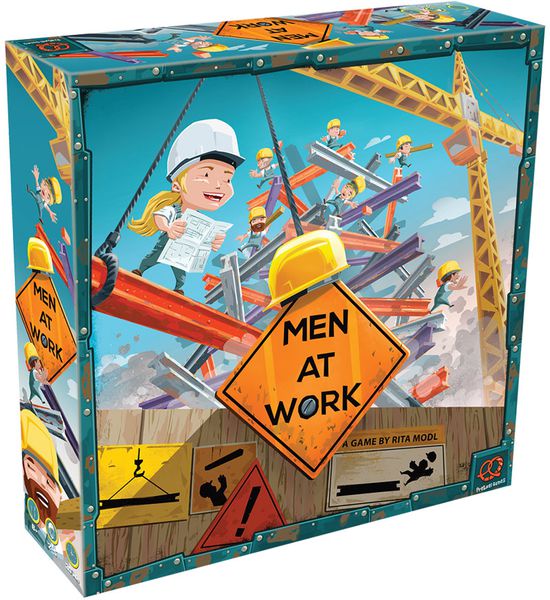
Men at Work
Player Count: 2 to 5
Price: $50
Gameplay Style: Dexterity
The simplest game on our list, Men at Work is a bit like reverse Jenga with a brick or two thrown into the mix. The premise tasks players with building up a chaotic construction site, complete with girders, beams, bricks and construction workers. Players must stack these components as directed by a randomly drawn card—which sometimes will throw a metaphorical wrench into the mix, forcing the player to stack with only one hand or in a specific manner. Cause the pile to collapse too many times and Boss Rita will take away your safety certificates, throwing you out of the game entirely.
Men at Work is what’s known as a dexterity game, meaning it’ll be your physical prowess that decides if you win or lose. The simple game comes with a tiny rulebook and an optional gameplay obstruction in the form of a crane players must build around. For those who want a game about taking risks rather than any clever thinking, Men at Work might be a great choice.
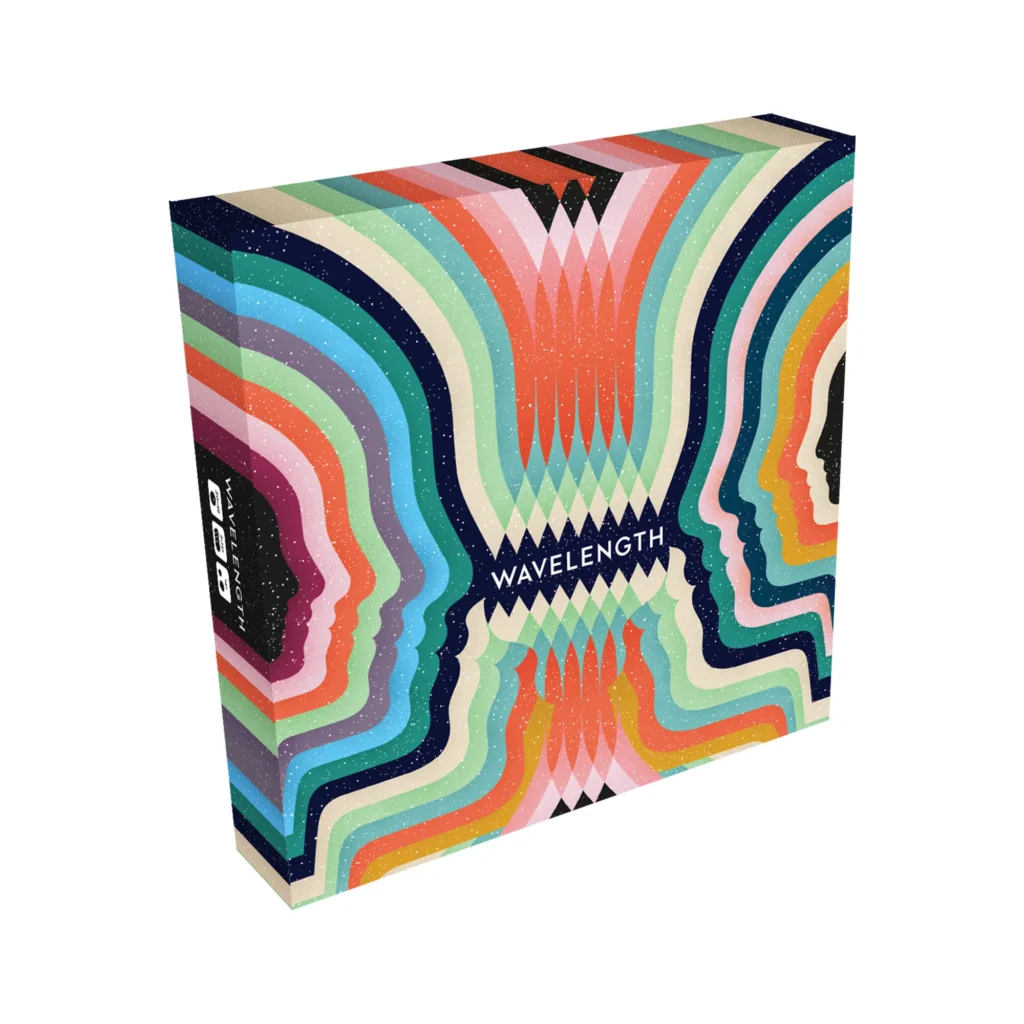
Wavelength
Player Count: 2 to 10+
Price: $35
Gameplay Style: Clue-Giving
Your friend spins Wavelength’s giant wheel, and he glances at it. You can’t see where the target is on it, but he can, and he’s formulating his answer based on what he sees. Then, he looks up at you, and he tells you the topic: “Hot or Cold.” Then, he gives you his answer: “Florida.” You begin to think about that word. Florida is certainly hot, you think, But it’s not as hot as the equator. Or lava. Or the sun. But very few people would describe Florida as cold. Second-guessing yourself the whole way, you eventually decide to choose somewhere leaning on the “hot” side of the wheel—but not to the most extreme side of that category. You watch as your friend reveals how close to the target you got.
That’s the essence of Wavelength as (usually) two teams compete against each other to prove that they’re the better team at reading their clue-giver’s mind. The team who guesses closer to the target based on their clue-giver’s word will get more points, and the team with the most points wins! The game is so simple, usually a single round of play is all that’s needed before everyone, regardless of age, knows exactly what to do. Though the game markets itself as 2 to 10 players, this is a game that could theoretically be played by as many as you wish—as long as you have room in your house. For families who enjoy clue-giving games, Wavelength will be a welcome addition to their shelf.
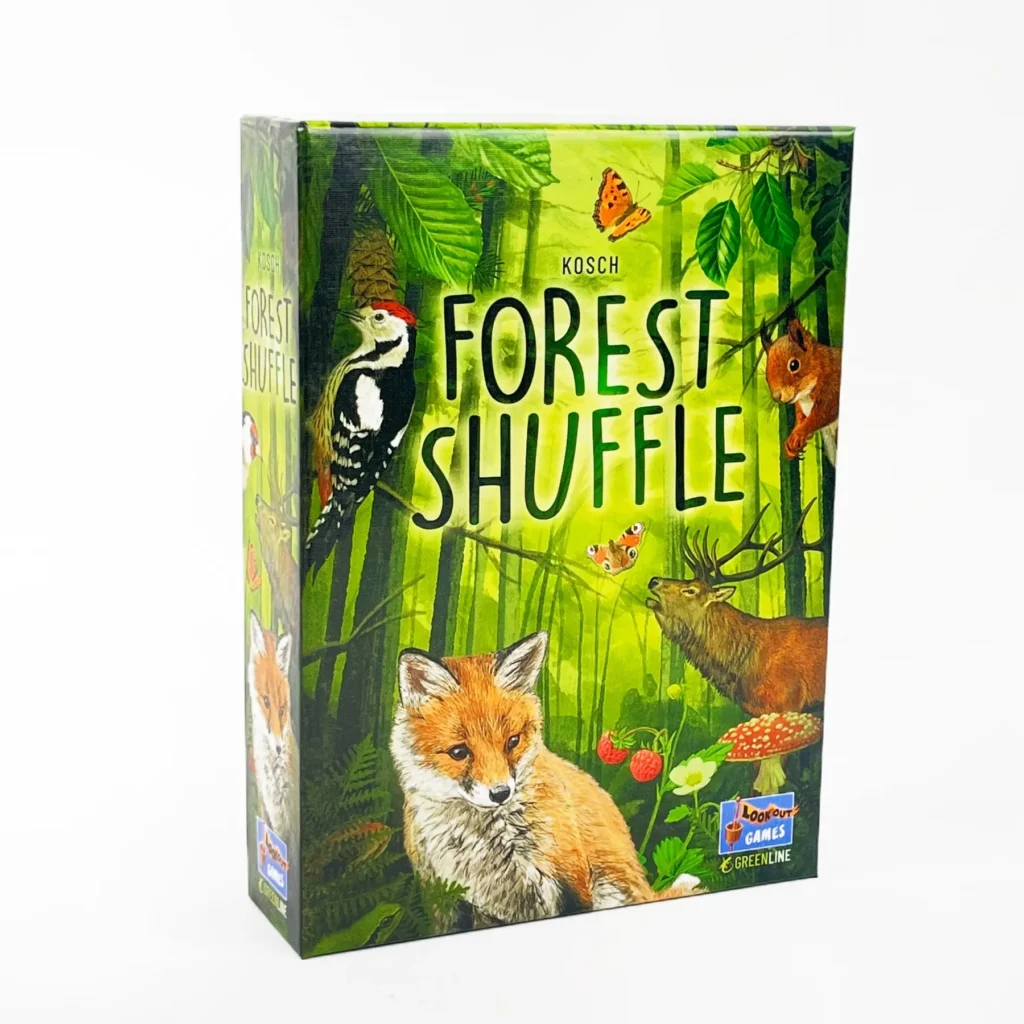
Forest Shuffle
Player Count: 2 to 5
Price: $30
Gameplay Style: Tableau Builder
Before you stand a variety of woodland creatures and trees. You’re allowed to take two of them—but which would be the best? You could take the butterfly, since you already have three, and their point value grows exponentially with each additional one. Maybe you’ll grab a Linden tree, too; if you have the most out of everyone, you’ll get three points per Linden. Oh, but that’ll leave the fox you need up for grabs, and you’re not confident another player won’t grab it first before it comes back to your turn. You look down at the forest you’ve built before you, filled with its many animals. Will it be enough?
This is where our list moves from simple party games and introduces a bit more decision-making. Forest Shuffle is a Tableau Builder—a game in which, over time, players accumulate a personal display of point-scoring or benefit-generating cards before them (in the same realm as Wingspan or Everdell). Each card they take has a different ability, and many of these cards will directly reference or play off other cards, leaving gamers with a variety of strategies to win. That means players can return again and again to try their hand at new ways to impress others around the table. For those who want a strategy game that is relatively quick to teach and has a cute aesthetic, Forest Shuffle is a prime choice.
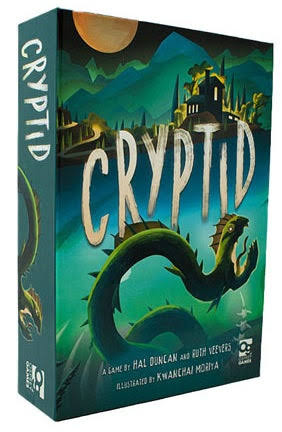
Cryptid
Player Count: 2 to 5
Price: $45
Gameplay Style: Logical Deduction
You stare at the map on the table. You don’t know where Bigfoot is—but you do know one thing: the hairy guy does not live in the desert. No one else around the table knows that, though. In fact, everyone else has their own clue as to where Bigfoot may—or may not—be. Wanting to be the first to discover the beast’s existence, you’ll go around the table, pointing at hexagons on the map and asking another player, based on their clue, whether Bigfoot could possibly live there. Over time, you’ll start to deduce what your opponents’ clues might be—and if you can figure all of them out, you’ll find the one hexagon where Bigfoot lives for certain.
It’ll likely take a full game before players truly grasp how to play Cryptid, but when they do, they’ll have a blast working out what their opponents’ clues are. In many instances, a player will think they’ve finally figured out someone else’s clue—just before new information comes that breaks that theory. Because the game requires a bit more logical deduction, this will be a game that works better with older kids. But for families looking to one-up each other in competitive competition, Cryptid will be a fun game to collect.
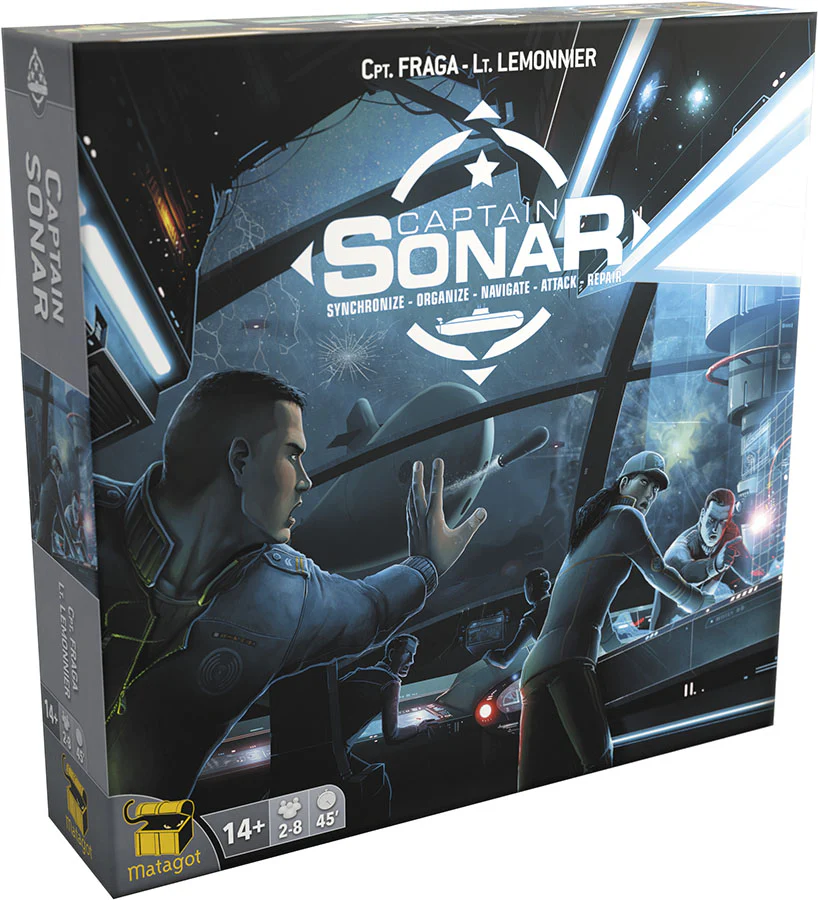
Captain Sonar
Player Count: 2 to 8
Price: $50
Gameplay Style: Real-Time Team-Based
Somewhere to your side, your radio operator listens to the enemy submarine, attempting to discover where their sub is. You, as the captain, command your own submarine to turn west, and steam hisses out of a broken pipe. Not to worry, the engineer is on that. “Captain, the torpedo is ready,” your first mate advises. “Once we find them, we can blow them out of the water.” Suddenly, alarms flare. The enemy submarine just used sonar—and they’ve found you. Battle stations ready. You’ll only survive by working together.
Though you can play with just two players, in my opinion, Captain Sonar is most fun the closer you are to eight. In the game, each player takes a different role in operating a four-man submarine, and each role is vital to your success or failure. With a divider splitting your side of the table from the other team, it’s the radio operator who must locate where their submarine is. The first mate charges all weapons, radar and stealth abilities of your submarine. The captain directs where the submarine heads next. And for every move the captain makes, something breaks down in engineering, forcing the engineer to determine repairs. And the only way you’ll win is by finding and destroying the other team’s submarine (who has the same roles) before they find and destroy you first.
Captain Sonar is a very thematic game, making players genuinely feel as if they were operating a submarine together. It is also much more complex than the previous games on this list, mostly in that each role has its own gameplay style and rules, each of which influence the other roles on your team in their own way. Because of that, explanation of the game will take a chunk of time. But once everyone settles into their roles and the game starts, you’ll be forced to work as a machine (well-oiled or otherwise). For older families searching for a competitive team-based bonding experience, you may want to ping Captain Sonar.

5 Responses
All of this flies under the assumption that your family isn’t too competitive to play board games peacefully together. In hindsight some of my favorite memories from my teenage years are Dad and I playing Axis & Allies and taking it so seriously that Mom got stressed out just being in the same room! Haha.
My family (7 kids ages 4-18, plus Mom and Dad) plays a lot of board/card games, and we will definitely be trying out some of the ones on your lists.
I love Blank Slate and Herd Mentality. Poetry for Neanderthals is good, but it’s really hard for younger ones because of the one-syllable rule – and as for the stick, ours busted not long after we got it :). Hues and Cues is okay, but I’m not a big fan because I find it too tricky. My siblings love Throw Throw Burrito, but it’s very fast and there’s the whole throwing-plush-burritos thing. If you like it, though, it has a companion game called Throw Throw Avocado. Just One is fun, but for me there was a caveat – you can’t win. It’s cooperative (which isn’t bad; cooperative can mean everybody wins or loses) but it’s based on a rating system – if you get zero cards, you need a lot of work, if you get seven, you’re pretty good, if you get thirteen, you’re an all-star, that kind of thing. So, I edited the rules to make it competitive.
A lot of these games could be made at home. (I googled it and it’s not copyright if you don’t sell/distribute it, use the game’s graphics, or copy the rules word-for-word. You could even read the rules and just rephrase them in your own words.) Plus, that way, you could edit them – for example, next time I go to my aunt’s, we’ll play Wing It: Extreme Storytelling, Star Wars Edition. Also, my family makes frequent trips to our library, which has some games to borrow.
Other great games:
Flip 7 – Player Count: 3-12 – Price: $8 – Gameplay Style: Push Your Luck
Flip 7 is a card game in which players compete to flip 7 cards without getting two of the same type of cards. There are some action cards and a unique deck of 12 twelves, 11 elevens, 10 tens, etc. Players must balance the desire for more cards, and thus more points, with the risk of picking up another card – you might bust! Though younger ones might not totally get it and will probably bust a lot, this is a good game for all ages.
Telestrations – Player Count: 4-8/4-12 – Price: $32/$45 – Gameplay Style: Sketching
Telestrations combines Telephone and Pictionary. Player 1 sketches a word and passes their sketchbook to the player 2, who guesses player 1’s sketch and passes the book to player 3, who sketches player 2’s guess, and so on until the sketchbook goes all the way around the table. There are points, but the most fun part of the game isn’t getting points but is seeing the progression of sketch-to-guess-to-sketch. You will be laughing, guaranteed.
Metro X – Player Count: 2-6 – Price: $40 – Gameplay Style: Strategy
Metro X utilizes dry erase boards with several different metro lines, each attached to a train car with 2-4 windows. Each line has 6-14 stops. Players draw number cards and cross off stops. The tricky part is that the lines criscross all over the place, and you MUST cross of the stops in order. Besides that, each card requires a train window, and once your train windows are gone, you can’t use that train’s line anymore. This isn’t a game for younger ones, but middle on up can have a great time. No game is the same, but you’ll get a pretty good feel for strategy once you’ve played it several times.
Scrambled States of America – Player Count: 2-4 – Price: $25 – Gameplay Style: Geography
If you want to learn U.S. geography (location, not topography), this is the game. My 8-year-old brother can locate all the states on a map because of this game, plus he knows some capitals. Each player gets a map and state cards, and must race to find a state that matches the clue card (state name starts and ends with A, state doesn’t touch an ocean, state capital has seven letters). It’s very fun and educational.
The company Gamewright has a lot of cool roll-and-write games such as Quixx, Qwingo, and Bloom.
We’re big fans of Ticket to Ride and Pandemic, but they are admittedly primarily for older kiddos. For the younger set, I like to play Sushi Go and Sleeping Queens (the latter of which also helps teach math concepts) as well as Outfoxed, which is kinda like Clue.
And for a classic…. Mille Bourne. It’s a favorite on family trips.
Thanks for the suggestions, these are really good.
Qwirkle, Azul, and Five Crowns are all some really good lesser-known games. Qwirkle involves arranging tiles into rows and columns by color and shape in order to score lots of points. Azul involves wisely choosing tiles from plates in order to complete a column on a grid. Five Crowns is a rummy-type game where the number of cards held and the wild card changes with each round. Ticket to Ride, Catan, Risk, Dutch Blitz, Rook, and Apples to Apples are some other fun ones.