Episode Reviews
July 30, 2026 – S2, E1: “Brute Force”
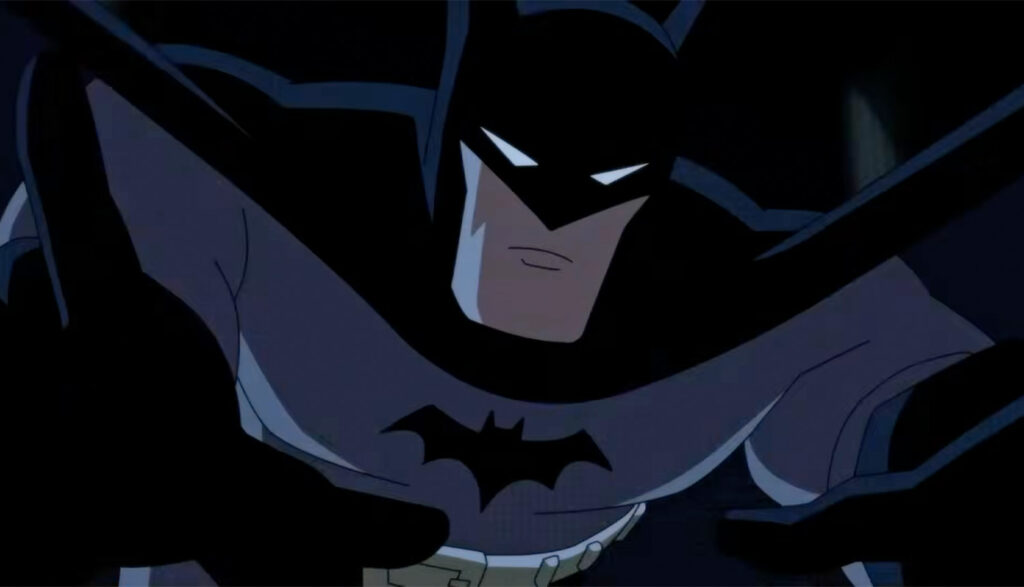
Crime is worse than ever on the streets of Gotham. Commissioner Gordon’s never-ending war against mob bosses such as Rupert Thorne ravages the city, and Batman begins to realize that one man can only do so much. But in a rare break in favor of law and order, Thorne’s accountant, Julian Gregory, is willing to testify against him–a move that might finally give our heroes enough dirt on Thorne to put him behind bars for good. The only problem is keeping Gregory alive long enough so he can actually spill the beans on his former employers’ dark deeds.
Viewers of Season 1 will be accustomed to the series’ habit of putting a twist on classic characters. In this case, the Riddler has been reduced to an angry hit man, one who frequently kills his own men. A hulking character based on Solomon Grundy appears, too, although his name is changed along with his typical character beats.
Most of the episode’s violence is caused by these two characters. A man is shot multiple times in the back, and another it shot in the head. Multiple men are chopped up by a plane propeller, and their blood canvasses the side of the aircraft. A man is injected with a formula that turns him into a raging monster, who then crushes multiple people who get in his way. The creature is stabbed multiple times and hit with a car repeatedly. A character is choked for information.
A male character gets out of a shower, his animated backside briefly visible in a blink-and-you’ll-miss-it shot. A male comments that his female coworker is a “looker.”
Mild language includes a use each of “d–n,” “hell,” “g-d–n,” along with a misuse of God’s name.
July 30, 2026 – S2, E4: “The Devil’s Due”
After a burglar is killed mid-heist by a group of men in bat costumes, Batman and Gordon must solve this bizarre murder before such media personalities as Hattie Tetch can use it to further their smear campaign against The Bat. The culprits left a bat symbol drawn from blood at the scene of the crime, pointing Batman in the direction of a recently resurfaced cult—one that worships the “demon bat god” Barbatos.
Caped Crusader tends to shuffle through a lot of the Dark Knight’s most prominent adversaries. But this “villain of the week” feels noticeably more sinister than others the series has covered, due in no small part to a heavy dose of occult spirituality. Cult members revel in the “terrible glory” their twisted savior will soon provide, assuming Barbatos gets the blood sacrifice he needs to rise again. They chatter excitedly about their “lord”, chanting “all hail Barbatos” on multiple occasions. While the mythology of this entity isn’t delved into deeply, and certain members of the cult are faking their belief for power, the distorted spirituality does feel dark, even for a Batman tale.
While the episode could have gone in an interesting direction about the corruption of faith and the danger of unfounded belief, it chooses to use its spirituality as a shallow plot element instead. A character remarks, “People like to believe in things–God, government, capitalism,” implying that their belief is just a way to feel like they’re a part of something bigger.
The cult’s bloodlust manifests itself visually in multiple stabbings and slashings. A character’s neck is snapped. Characters drink alcohol and offer it to others. Mild language includes a use each of “a–” and “b–tard.”
Aug. 1, 2024—S1, E1: “In Treacherous Waters”
Gotham gangster Rupert Thorne is concerned about a new crime lord horning in on his territory, and he’s not alone: Batman is, too. Worse yet, this new player is more than happy to blow up buildings to make a point. But turns out, this “crime lord” is a lady: a cabaret singer known as Penguin. And in this game of crime, she’s playing for keeps.
We witness a frenetic gun battle. A man is shot and killed. Another is locked in a chest and dropped into the sea. A couple of buildings are blown up (apparently without casualties), and we hear about a couple other explosions, too. A few people are hit by a car. Batman hangs a man in front of a speeding train as an “encouragement” to talk. Missiles are fired. Batman engages in several physical altercations.
Some animated women display a bit of cleavage. Revelers drink what appear to be champagne and martinis on a nightclub/yacht, with Bruce Wayne making several jokes about alcohol. Characters say “a–,” “d–n” and “crap,” and God’s name is misused at least seven times. We also hear f-word stand-ins like “freaking” and “frigging.”
Aug. 1, 2024—S1, E2: “And Be a Villain”
Batman and Detective Renee Montoya both investigate the mysterious disappearance of a famous movie actress. But the missing persons case turns into murder when Montoya discovers the actress’ co-star, Basil Karlo, has been stabbed to death.
The culprit is not pretty. While we don’t see most of his face until the very end, the glimpses we do get depict the killer as a near-corpse with a disfigured face. We see several other dead bodies as well: One we see murdered (as he stands in liquid into which an electrical light is toppled); another stares vacantly as a spider crawls across his eyeball; a third lies in the morgue with a curiously squishy face.
Batman’s butler, Pennyworth, watches a movie featuring the missing actress, where she writhes on a stone slab, wearing a tight, cleavage-revealing dress, as a scythe slowly descends. (Later, that same scene is repeated with murderous intent.) People are punched. Two characters engage in a swordfight. Someone is injected with a syringe of something off-camera. We hear single uses of both “d–n” and “h—.”
Aug. 1, 2024—S1, E3: “Kiss of the Catwoman”
The Gotham Museum is displaying some of the city’s most fabulous jewels, including some literal gems from the Wayne family. Selina Kyle, a mysteriously lucky jewel thief toying with the idea of creating a costumed alter-ego, is eying a particularly attractive set of pearls owned by Bruce Wayne. Batman certainly can’t have that. But when a reporter makes a crack about those pearls and their role in the death of Bruce’s mom, the normally mild-mannered playboy socks him one—which earns him a stint with a counselor to deal with his anger issues.
“Have you ever found yourself resorting to violence in other situations?” asks his psychiatrist, Dr. Harleen Quinzel. He denies it, but we know better.
In flashback, we hear the gunshots that killed Bruce’s parents when he was a boy, and we see the young lad transition from unremitting grief to an unrelenting desire for vengeance. As Batman we see him fight with a couple of corrupt police officers and wrestle a black panther. Kyle tangles with people, too—giving the face of one policeman some bloody clawmarks. She’s grazed in the thigh with a bullet, leading to a bit of animated bloodshed. Kyle socks Batman in the gut with electric brass knuckles and nearly runs him over with her car.
But Catwoman also kisses Batman rather leisurely. Kyle jokes with Bruce Wayne that she’s about the only single woman that Bruce hasn’t dated. Speaking of Bruce’s womanizing, Quinzel asks her patient if any of his myriad conquests has meant anything to him. “Is there even love there, or even lust?”
We hear “a–,” “crap,” “h—” and one misuse of God’s name.
Aug. 1, 2024—S1, E5: “The Stress of Her Regard”
Some of Gotham’s greediest tycoons have mysteriously given their money to charity, or mysteriously disappeared, or mysteriously … turned into deranged costumed third-tier villains. Both Batman and Barbara Gordon are determined to figure out why. But the evidence leads straight to the door of an eminent psychiatrist both know well: Harleen Quinzel.
Quinzel is revealed to be Harley Quinn, of course. In established Batman canon, she was an impressionable young therapist who was warped and ultimately broken by Joker, with whom she has a deeply disturbed (and mostly one-sided) romance with. But here, Harley’s romantic inclinations swing the other way: The smitten shrink asks Det. Renee Montoya out for dinner, and the two share a kiss before Quinzel runs out to take care of a bat in her belfry.
That belfry is filled with some very odd characters (at least some of which are D-listers in Batman’s traditional Rogue’s Gallery), and Batman ultimately tangles with all of them simultaneously. (People are hit and thrown, and one character sports a black eye.) Elsewhere, Batman also knocks out several policemen. A man tries to jump off a rooftop. One guy under the influence of Quinn attacks another with a sledgehammer (albeit off camera). Another man is tickled into submission. A couple of people fall victim to sleeping gas. A building explodes, and a great deal of its wreckage slides off a cliff into the sea—nearly carrying a few people with it. (A couple of characters indeed fall into the waters below, but both ultimately survive.)
Quinzel and Montoya drink wine during dinner. A character believes he’s the ancient Egyptian king Tutankhamun, and we see various Egyptian artifacts (many of which had religious significance in that ancient culture) in his secret lair. Characters say “d–n,” “h—” and misuse God’s name once.