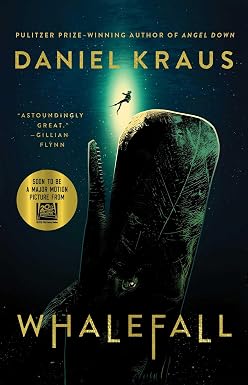
Whalefall

Credits

Age Range

Publisher

Awards

Year Published

Reviewer

Jonah Parker

Book Review

When a famed California diver takes his own life in one last dive, his estranged son, Jay, is determined to recover at least some of his dad’s remains. But Jay’s not the diver his father was, and the waters he’ll be navigating are treacherous. And while he didn’t think one of those dangers would be getting swallowed by a giant whale, he’d be wrong.

Plot Summary

Jay Gardiner has a lot to live up to.

His late father, Mitt, was an infamous diver throughout the Monterey area. Beloved by fellow divers but misunderstood by the tourists he despised, Mitt spent more time in the sea than he did on land. He saved dozens of divers from nitrogen narcosis and jagged underwater spires, earning an almost mythical level of respect. Jay tried to follow in Mitt’s finned footsteps, but he was never the man his father was—a fact that fellow Monterey divers always seemed to take note of.

But when Mitt received a terminal cancer diagnosis, and Jay refused to see his dying father due to the two men sharing one too many harsh arguments, Mitt determined a life without diving is not one worth living. The local legend takes his own life–one last weighted dive into the ocean that he loved more than anything else.

Maybe Jay could have convinced him not to kill himself. Seems like a lot of pressure to put on the shoulders of a high schooler—but people love someone to blame, and right now, that seems to be Jay.

If only Jay could execute one last dive, to find even one of his dad’s bones. To prove he can be the diver his dad taught him to be, and to give his family the closure of burying something.

The only thing that can get in his way now? The harsh, unforgiving and unpredictable nature of the sea. As well as the beasts that inhabit it.

Luckily for Jay, at least some of those oceanic mastodons don’t prefer to feast on humans. Take the sperm whale for example—an animal that would rather snack on giant squid than a tiny human. But when a squid wraps a tentacle or two around Jay, the whale decides that a little extra protein won’t hurt him. And with that, Jay  ends up in a situation he thought was relegated to a specific minor prophet.

Christian Beliefs

The novel consistently intersplices half-hearted Christian references, especially as a gravely injured and oxygen-deprived Jay begins to see whales as his father did—borderline celestial beings. Whales and the sea life surrounding them are described as angels, demons and gods. A family friend of the Gardiners reports that “angel” and “sailor” are homophones in Hebrew.” Jay refers to the New Testament as the “new testicle” on multiple occasions.

Clearly confused from being partially raised under his dad’s spiritual connection to the sea with a mixture of his mom’s protestant beliefs, Jay doesn’t seem to care too much for either spiritual avenue. When contemplating his father’s suicide, he considers that both Christianity and Judaism are “inside out” about the topic, and that “whoever wrote the rules didn’t have cancer.” He also ponders the perceived irony that “Jesus knew what he was doing with that cross, and his rep is still pretty good.” (Lines like these make it obvious that there is clearly a disconnect within his perception of Christianity.)

Other Belief Systems

As mentioned, Mitt’s reverence for the sea is his religion. The man sports a large tattoo covering his back that reads “our father who art in nature,” some personal art that Jay reports was meant as “a middle finger” toward organized religion.

Family friend Hewey is said to be of the Jewish faith, but he also carries around a Quran and a New Testament at different points of the novel. Mitt instructs Jay about how the Inuit peoples worshipped the whales they hunted, using every part of the beast for food, housing, and religious ceremonies.

Jay’s nihilistic view of religion seems to stem from a mixture of being unable to come to grasp that of the multiple faiths of his family and friends, only one of them can be “right.” It is at least partially because of this that he claims to be an atheist—but by the end of the novel, he at least understands his father’s spiritual reverence for the ocean. Claiming that his god is his own oxygen cannister, the last chunk of the novel especially incorporates heavy heapings of religious allegory that do little more than act as some literary set dressing.

For instance, the author compares an ecosystem of life feeding on a dead whale to “communion.” Moments like these feel less profound the more frequently they are used—initially hinting towards some sort of spiritual catharsis but becoming eye-roll worthy towards the end.

Authority Roles

Jay’s parents provide the main authoritative roles in the novel, with Mitt’s presence being the more harmful one to Jay. His love is expressed almost entirely through Mitt’s impatient recitation of survival facts and insistence that his son can be as good a diver as he is someday.

Jay’s sisters don’t see this side of Mitt—a fact that clearly bothers Jay. He longs for the kind father that they received, and he’s confused as to why he is excluded from the warmth his sisters received. This difference in parenting causes Jay to internalize that it must be his scrawny nature, his tendency to cry when upset, or his lack of interest (at least, in comparison to Mitt’s obsession) with the ocean that is dividing him from his father.

Mitt struggles to hold a job and seemingly prefers the ocean and its creatures to anything else in his life—at times, even including his own family. When progressing cancer will clearly make it impossible for Mitt to continue diving, Mitt takes his own life rather than spending his final days surrounded by friends and family.

Jay’s mother, Zara, on the other hand is an excellent, loving mother. Jay recalls finding solace in his mom’s stable love, especially when juxtaposed with his father’s fickle nature.

Profanity & Violence

Jay’s inner monologue, as well as his memories of Mitt, include a fair amount of foul language. Per chapter, each being a few pages, readers can expect a use of the s-word or f-word. The book is littered with around 50 of the former and at least 30 of the latter. In addition to these profanities, less frequent but notable uses of “b—ch,” “d—n,” “h—,” “a—,” and misuses of both God and Jesus’ names float to the surface of the page.

Post consumption, Jay’s physical well-being obviously deteriorates fast. The poor young man’s body comes about as close to death as humanly possible throughout the novel, and readers quickly become privy to lengthy descriptions of his every injury. As he is literally being digested, deep gashes, acidic burns, broken bones, shattered eardrums, and even the loss of body parts becomes commonplace.

Mitt is quite the drinker, and his inebriated state causes him to say and do things he later regrets.

Sexual Content

In a conversation with the voice of Mitt within the whale, his father asks Jay if he has a girlfriend or boyfriend. While Jay doesn’t have a significant other of either gender, he reports that he appreciates that his “father” wouldn’t care who he loved.

Earlier in the book, Jay recalls how girls have always been easier for him to get along with than boys. Although friends have wondered if Jay is same-sex attracted, he reports that he “isn’t gay, at least… not mostly.”

Some descriptions of oceanic creatures can be described using vernacular that harkens to items humans use in sexual situations. “Jellyfish like lacy lingerie” is an example of this notion. Jay and his father both recall a section of the John Steinbeck novel Cannery Row in which a group of prostitutes fashion a quilt out of lingerie.

Discussion Topics

Parents can discuss the dynamic between Mitt and Jay. It’s clear both men were missing the intentions of the other—with Mitt’s tough love manifesting in his near constant survivalist instruction of Jay, and Jay’ reluctant participation to attempt to win his dad’s favor. What conversations might these two have had to solve this miscommunication? Is the resolution of this mutual hurt their shared responsibility, or is it more on the shoulders of the father?

The book implies that the closest Jay comes to believing in a higher power is at the height of his desperation to survive within the whale. Do we as Christians tend to lean more on God when it’s beneficial, or in this case, essential to do so? And when the crisis passes, do we sometimes, like Jay, go back to trusting only in ourselves?

Additional Comments

Whalefall begins as an intriguing spin on a classic tale of survival. But as readers are plunged into Jay’s quest for closure and redemption, mileage on the satisfaction provided from the book’s destination may vary. While well written and certainly intense, the heavy-handed spiritual conclusions found in the depths of the sea are as murky as the water itself.

In many cases, claiming a film adaptation of a book is “better” than its source material is treated as a heresy from avid readers—and while the claim is entirely relative, a few differences between the two are worth pointing out.

The due to the constraints of a theatrical runtime, the film wisely chooses to omit much of the dead-end faux religious metaphors in favor of rich character development. And, in sticking with a PG-13 rating, it cleanses much of the consistent harsh profanities that the book has to offer.

Kraus certainly knows how to construct short chapters that leave readers thirsty for more. His prose heightens the intensity of what is surely one of the most niche, cruel situations a human can find themselves in. When the journey ends and the words run dry, many readers will find themselves swimming in a polluted sea of intriguing spiritual concepts without any solid resolution, along with grotesque descriptions of bodily harm and harsh profanities.

You can request a review of a title you can’t find at letters@pluggedin.com.

Book reviews cover the content, themes and worldviews of fiction books, not necessarily their literary merit, and equip parents to decide whether a book is appropriate for their children. The inclusion of a book’s review does not constitute an endorsement by Focus on the Family.

Jonah Parker

Jonah Parker’s first interaction with Plugged In came when he was just five years old, after his parents read a review for The Chronicles of Narnia: Prince Caspian and deemed the content too intense for him. What started out as a contentious relationship between Jonah and a staff of reviewers who knew not of his existence would later turn into an appreciation for the site’s ability to present media content in a way that was accurate and fair. Jonah enjoys analyzing how our entertainment echoes the creativity of our Creator while finding glimpses of Biblical truths within every genre. He believes that Robert Pattinson’s Batmobile is the perfect mix of cool and practical.